How Does Will Work?
A deep dive through Angel's Trumpet into the machinery of consciousness


Angel’s Trumpet, or Brugmansia, is native to tropical South America. Its tissues contain tropane alkaloids, including scopolamine, that block muscarinic acetylcholine receptors. At sufficient exposure, the result can be a dangerous anticholinergic delirium marked by confusion, hallucinations, impaired attention, and severe disruption of memory.
In Ecuador, friend-of-a-friend stories circulate about strangers who blow powdered borrachero into someone’s face and then command the victim to empty a bank account, surrender a car, or help carry valuables out of their own home. The details blur into folklore, crime reporting, and myth. Scopolamine is not a dependable obedience drug. Delirium is messy and unpredictable. Still, the stories open a real and fascinating rabbit hole:
How can a chemical leave perception and movement partly online while weakening the capacity to form an intention, hold it in mind, and veto someone else’s?
The answer points toward a broader claim. Will is not a metaphysical switch hidden in one brain region. It is an activity the nervous system must keep constructing. Attention has to select a target. Memory has to preserve context. Salience has to assign value. A self-model has to register, I am the one doing this. Metacognition has to compare the current act with that model and interrupt the act when something is wrong.
Scopolamine is revealing because it attacks several of those operations at once.
Mind control by subtraction
The popular story imagines scopolamine adding a command channel to the brain. A more plausible model is almost the reverse: it subtracts the internal processes that normally compete with an outside command.
Acetylcholine helps the brain select information, encode new memories, sustain cortical activation, and coordinate the moment-to-moment continuity of experience.1 Block central muscarinic signaling and the person may still hear words, recognize objects, retrieve some older memories, and perform familiar actions. What becomes unreliable is the workspace that binds those fragments into a stable account of what is happening now.2
That failure has several layers:
New events do not encode reliably. The last few moments cannot stabilize into usable context.
Working memory loses its grip. The person cannot keep a goal, warning, or contradiction active long enough to act on it.
Self-monitoring degrades. Behavior continues, but the system that tracks what am I doing and why? becomes intermittent.
The internal veto weakens. Risks, alternatives, and intentions are no longer represented strongly enough to compete with the instruction in front of the person.
This does not guarantee compliance. It produces confusion, agitation, passivity, hallucination, or disorganized behavior in different people and at different doses. But it helps explain the eerie possibility behind the stories: an externally supplied script can become disproportionately powerful when the person’s own narrative can no longer remain active.
The body is still onstage. The author has lost the thread.
Acetylcholine is one pillar, not the whole building
It would be a mistake to map acetylcholine directly onto consciousness or free will. No neurotransmitter owns a human faculty. Each modulator changes the conditions under which large neural systems operate.
Acetylcholine (ACh) tunes selective attention, memory encoding, and the precision and continuity of the current scene.
Norepinephrine (NE) tunes arousal, vigilance, and signal-to-noise.
Dopamine (DA) assigns motivational salience, prediction error, and effort.
Serotonin (5-HT) alters mood, constraint, and the flexibility of higher-order models.
Glutamate and GABA carry much of the fast excitation and inhibition from which actual percepts, thoughts, and rhythms are built.
Consciousness is therefore better pictured as a state across several interacting axes than as the output of a single chemical dial.
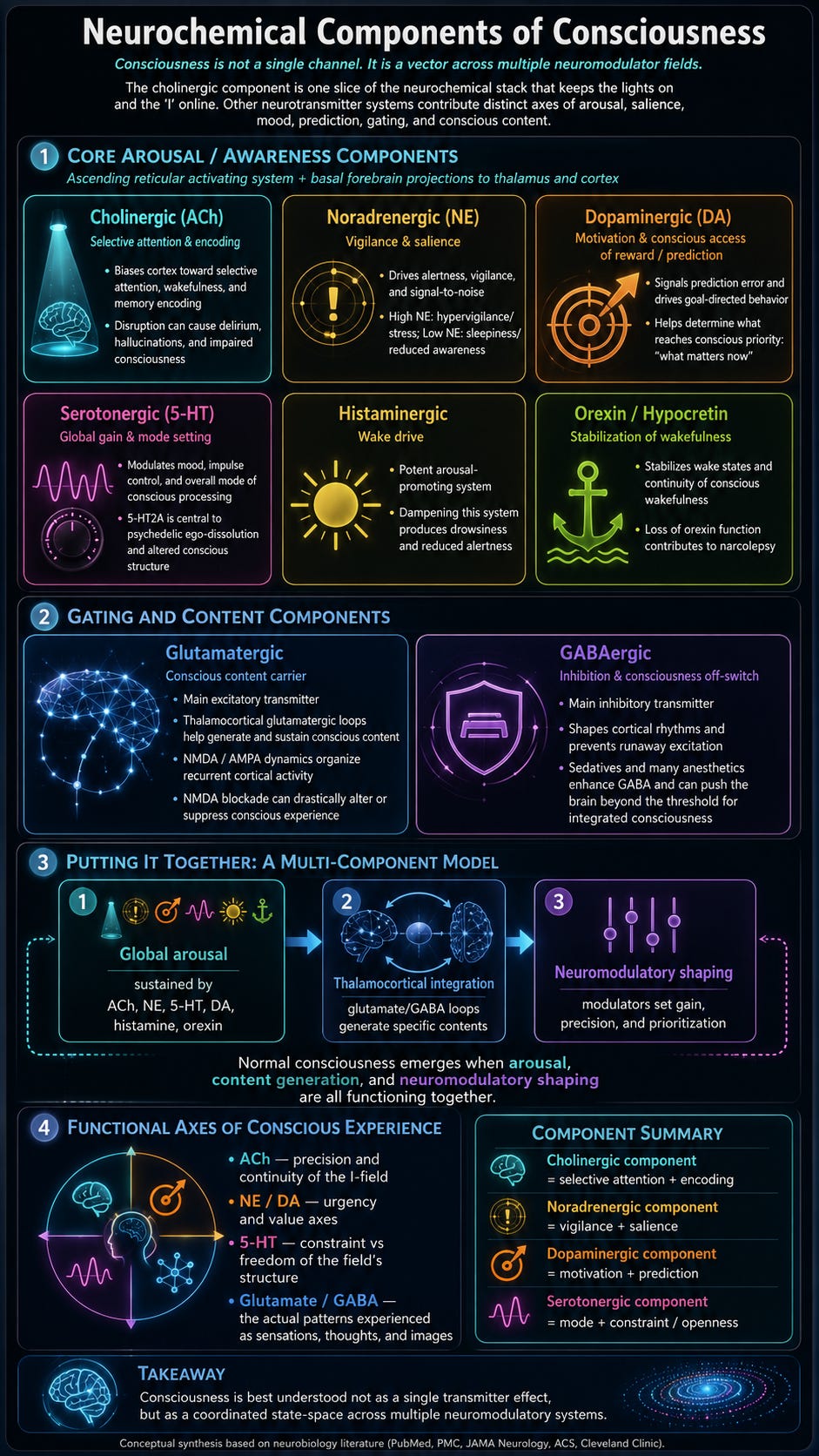
Acetylcholine also plays a role in dreaming that may be instructive. Cholinergic activity is strongly involved in REM. In a non-lucid dream, imagery and action can unfold while reflective awareness remains weak. In a lucid dream, the dreamer recovers the higher-order recognition, this is a dream and I am in it. Cholinergic enhancement with galantamine has increased lucid-dream frequency in controlled work, especially when combined with sleep interruption and mnemonic training.3
Scopolamine can create a waking analogue of the non-lucid side of that contrast. The scene continues, but the part of the system that knows it is a scene, remembers how it began, and checks whether it makes sense is attenuated.
That is a kind of ego loss, but not the only kind.
The DJ in the mix: thalamocortical loops
Neurotransmitters set conditions. Circuits make those conditions into an experience.
The thalamus and cortex are joined by dense recurrent loops. Cortex sends extensive feedback into thalamic nuclei, and the thalamus routes activity back toward cortex. These are not simple one-way relays. Their timing, synchrony, and recurrent exchange help determine whether the brain is awake and integrated, which signals gain conscious access, and whether separate features bind into a reportable scene.
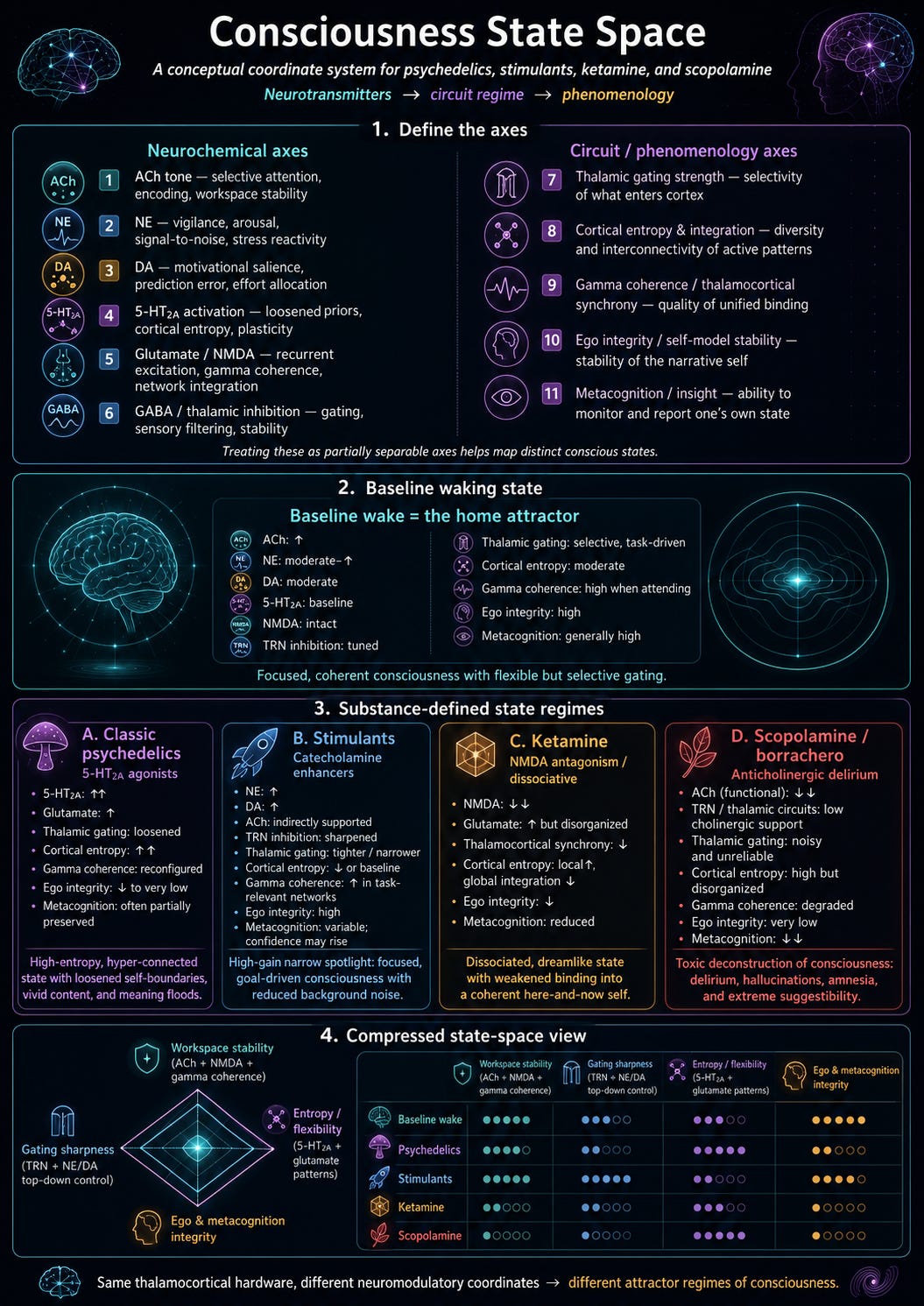
If neurotransmitters are the control dials, thalamocortical loops are the live mix. The same basic hardware can settle into very different regimes: focused waking, dreaming, delirium, psychedelic expansion, dissociation, or anesthesia.
Recent human intracranial recordings add weight to this systems view. During a visual-awareness task, activity associated with conscious perception appeared earlier and more strongly in high-order thalamic nuclei than in prefrontal cortex, with transient thalamofrontal synchrony accompanying conscious access.4 That does not settle the hard problem of consciousness, but it makes a cortex-only story harder to defend.
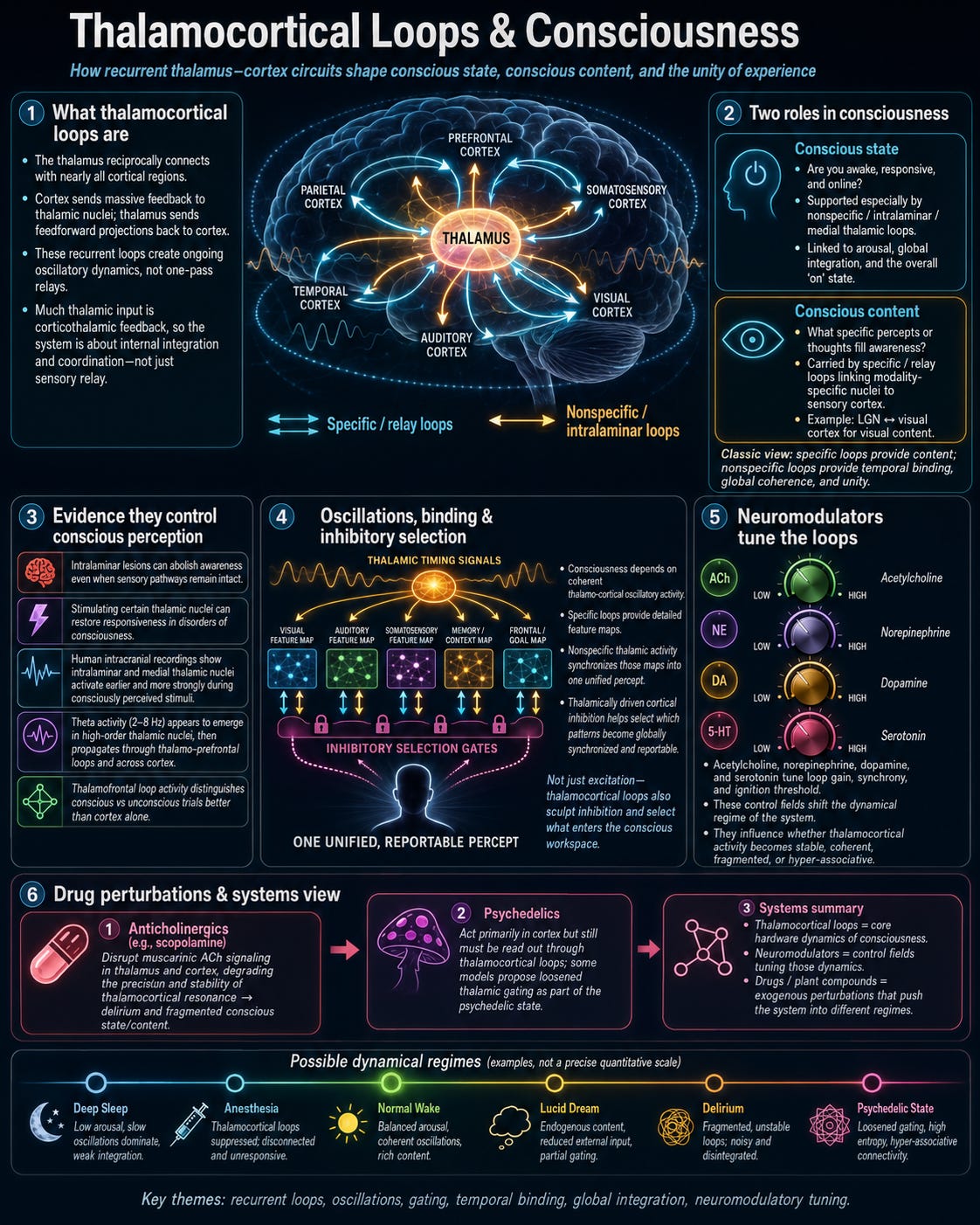
This gives us a cleaner description of scopolamine’s effect. Blocking muscarinic ACh signaling does not merely turn down alertness. It changes the gain and stability of the networks that sustain attention, encoding, and coherent thalamocortical exchange. The result can be a fragmented conscious field with enough sensory and motor function for behavior, but too little continuity for reliable authorship.
The gatekeeper: the thalamic reticular nucleus
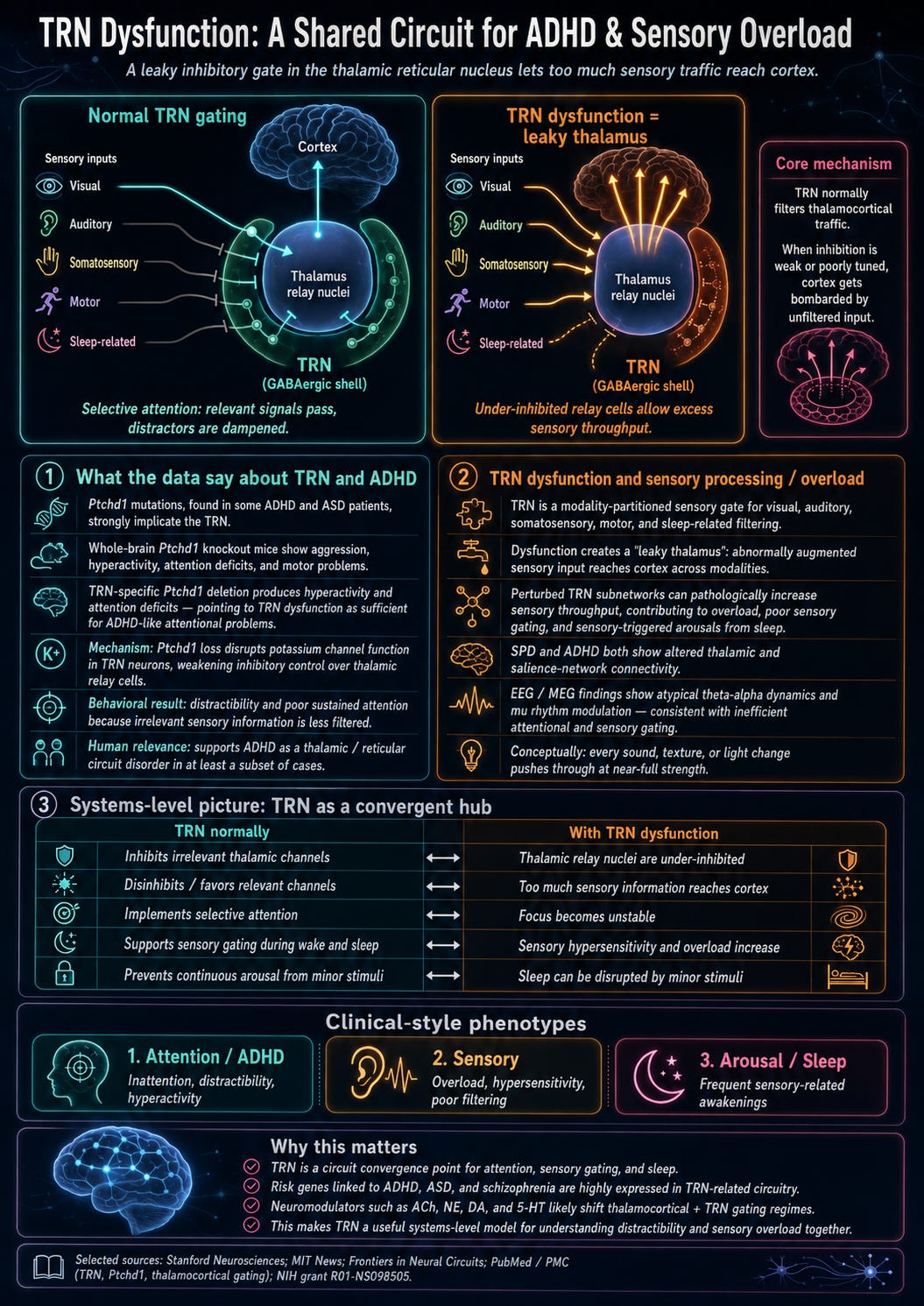
Wrapped around the thalamus is a thin sheet of inhibitory neurons called the thalamic reticular nucleus, or TRN. It receives collateral input from both cortical and thalamic pathways and sends inhibition back into thalamic relay nuclei. That anatomy places it in a remarkable position: it can help decide which channels are amplified, which are suppressed, and how sharply attention moves.
The old spotlight metaphor becomes physical here. Attention is not only a beam pointed by an executive homunculus. It is a competition among pathways, shaped by top-down goals, bottom-up salience, local inhibition, and neuromodulatory state. The TRN is one of the main control surfaces for that competition.5
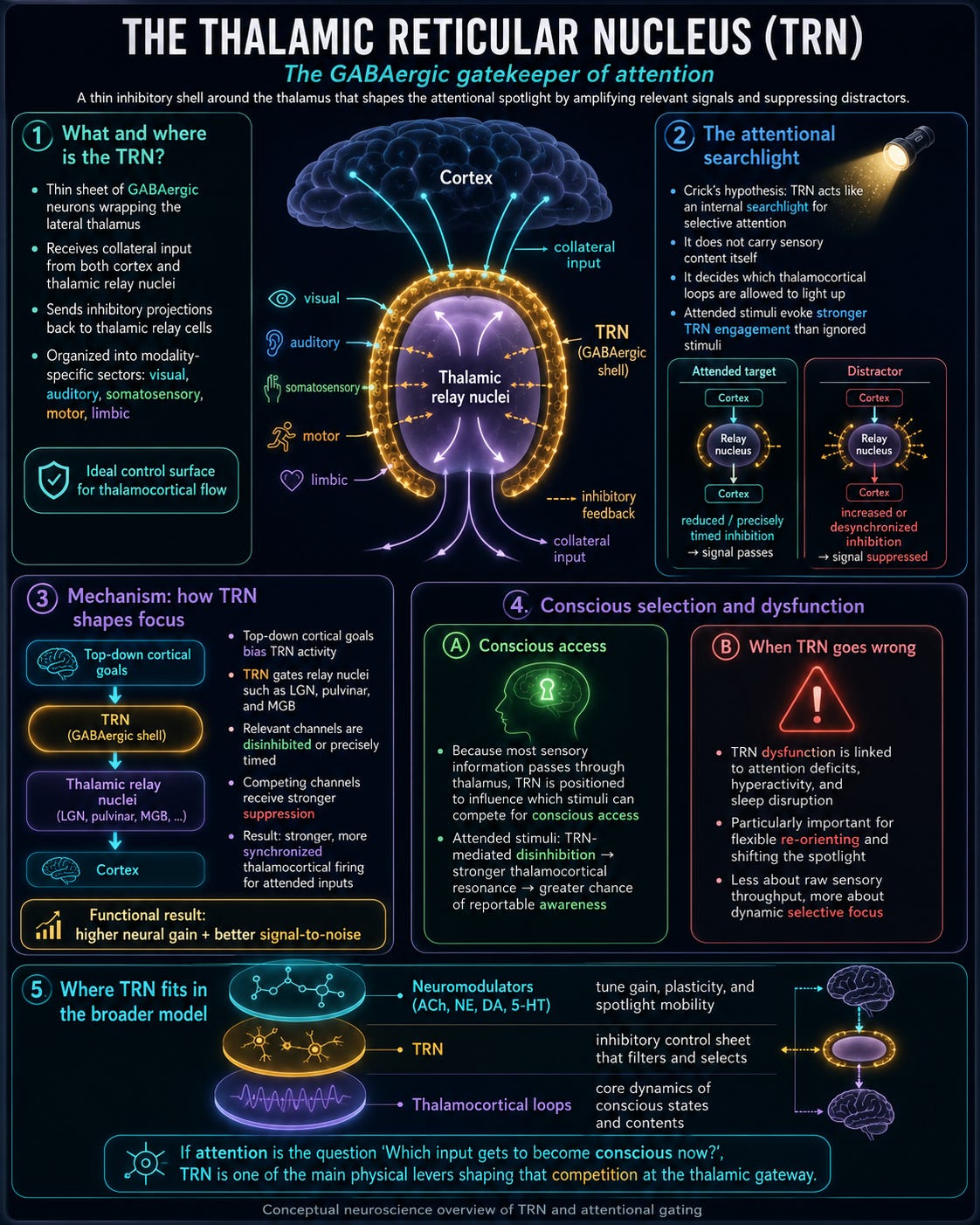
This also explains why acetylcholine should not be treated as a free-standing substance of will. ACh, NE, DA, and 5-HT alter the gain, plasticity, and mobility of the spotlight. The TRN shapes inhibition at the gateway. Thalamocortical loops build recurring patterns. Cortex supplies goals, predictions, and narrative structure. Will emerges from the coordinated operation of the stack.
A side route through attention and sensory overload
The TRN model also connects to attention disorders, sensory overload, and sleep disruption. Some animal and genetic findings implicate TRN-related circuitry in ADHD-like attention problems, and the circuit’s modality-specific organization makes it a plausible convergence point for filtering across vision, audition, touch, motor signals, and sleep-related arousal.
That connection should remain a model, not a total explanation of ADHD or autism. The bridge from a gene or mouse circuit to a heterogeneous human condition is long. Still, the comparison is useful. A chronically leaky gate could produce distractibility and overload; an acutely destabilized gate under a deliriant could contribute to a much more global loss of coherent selection.
Ego loss is not one state
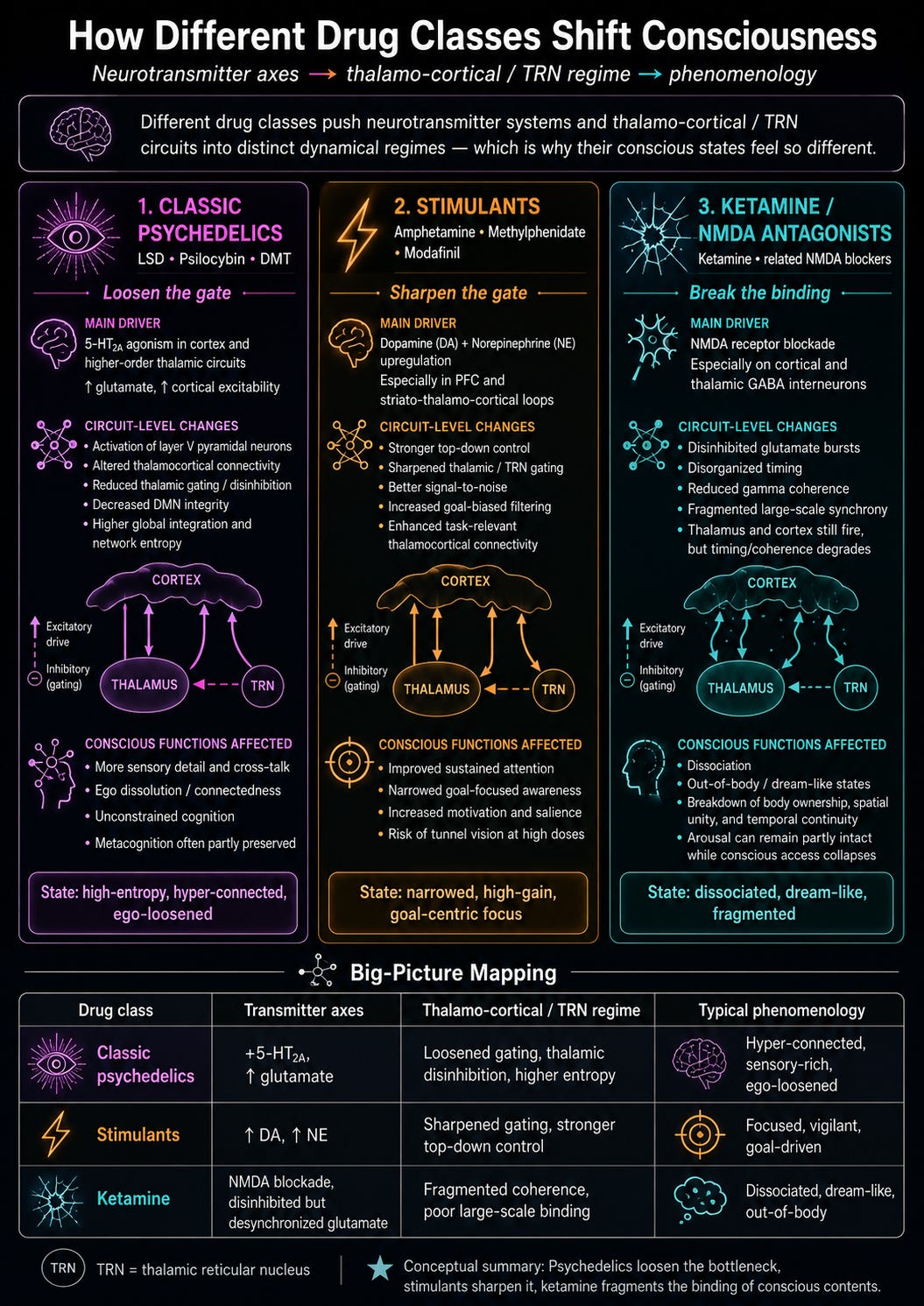
Scopolamine, classic psychedelics, and ketamine can all disturb the ordinary sense of self, but they do not arrive at the same phenomenology by the same route.
Classic psychedelics act primarily through 5-HT2A receptors and can loosen high-level priors, alter default-mode network organization, and expand the repertoire of active brain states.6 The self-model becomes more permeable, but the subject can often observe and later narrate that transformation. Ketamine reaches another neighborhood through NMDA receptor antagonism, disrupting binding and bodily or narrative self-representation in a dose- and context-dependent way.7
Anticholinergic delirium is different. It is less like rewriting the story and more like losing the working document while the performance continues.
So how does will work?
The scopolamine puzzle suggests that will depends on at least four coupled capacities:
Continuity: preserving enough of the recent past to know what the present means.
Competition: holding multiple possible actions, risks, and values in the workspace at once.
Ownership: tagging an intention or action as mine within a stable self-model.
Veto: detecting a mismatch and inhibiting the action before it becomes behavior.
These capacities do not live in a single molecule or location. Acetylcholine helps maintain precision and continuity. Dopamine and norepinephrine assign value and urgency. Serotonin changes the rigidity or openness of the model. Glutamate and GABA generate and constrain the patterns themselves. Thalamocortical loops bind those patterns into a conscious field, while structures such as the TRN help determine what enters and persists.
Scopolamine does not prove where the self lives. It shows that the self has dependencies.
Pull out enough cholinergic support and the internal narrative loses temporal depth. Alternatives stop competing. Error signals fail to persist. The externally supplied instruction is no longer one voice among many; it may be the only sentence left under the spotlight.
This is the unnerving lesson hidden inside the borrachero stories. What we call free will may not be an indivisible force. It may be the felt result of a nervous system successfully remembering, selecting, valuing, monitoring, and vetoing in real time.
The “I” is not merely present. It is continuously rebuilt.
Perry E, Walker M, Grace J, Perry R. Acetylcholine in mind: a neurotransmitter correlate of consciousness? Trends in Neurosciences (1999).
Miravalles C, Cannon DM, Hallahan B. The effect of scopolamine on memory and attention: a systematic review and meta-analysis. European Psychiatry (2025); Pal D, Mashour GA. Consciousness, Anesthesia, and Acetylcholine. Anesthesiology (2021).
LaBerge S, LaMarca K, Baird B. Pre-sleep treatment with galantamine stimulates lucid dreaming: a double-blind, placebo-controlled, crossover study. PLOS ONE (2018).
Fang Z et al. Human high-order thalamic nuclei gate conscious perception through the thalamofrontal loop. Science (2025).
Pinault D. The thalamic reticular nucleus: structure, function and concept. Brain Research Reviews (2004); Tokoro K et al. Thalamus and Attention. Brain and Nerve (2015).
Stoliker D, Egan GF, Friston KJ, Razi A. Neural Mechanisms and Psychology of Psychedelic Ego Dissolution. Pharmacological Reviews (2022); van Elk M, Yaden DB. Default Mode Network Modulation by Psychedelics: A Systematic Review. International Journal of Neuropsychopharmacology (2022).
Mollaahmetoglu OM et al. A unified model of ketamine’s dissociative and psychedelic properties. Journal of Psychopharmacology (2023).